Nobody gets particularly excited about preparing the weekly status report.
Someone tracks down updates, reads through meeting notes, checks what changed, and turns it all into a format someone else can use. Then they do it again next week. 🙄
It probably won’t headline your organization’s AI strategy. But if you’re looking for a useful place to start, this kind of work deserves a closer look.
Your best AI use case may be hiding in the routine tasks people have learned to tolerate.
Work that takes longer than it should. Information that needs reviewing and organizing. A first draft that requires pulling details from several places.
These opportunities can seem modest alongside the promise of reinventing an entire business function. Yet a well-chosen, practical AI use case gives you something valuable: a specific problem to solve and a way to determine whether you’ve actually improved it.
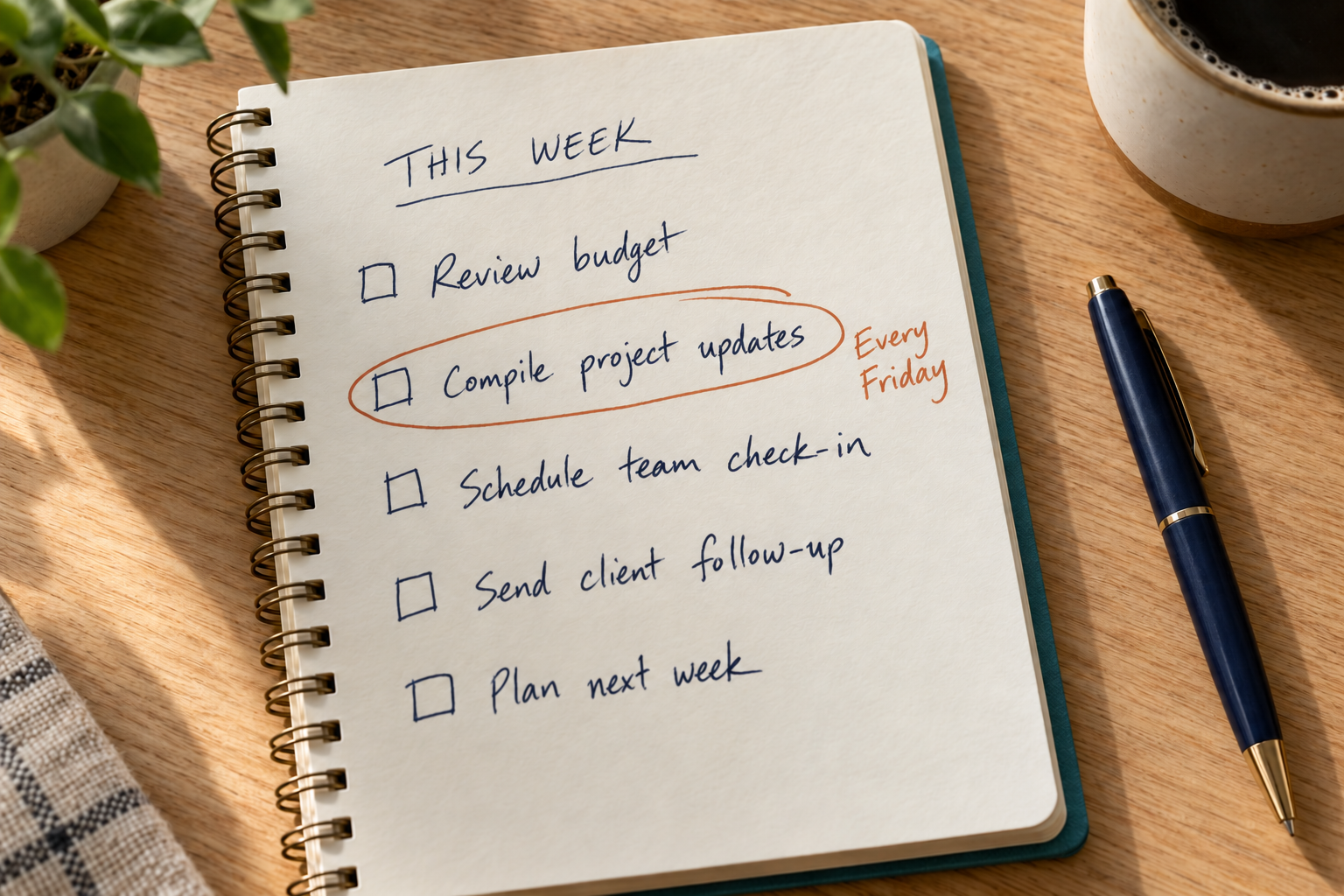
Start with the work people keep doing
“What could we do with AI?” is an understandable question. It’s also broad enough to send a planning meeting in almost any direction.
A more useful starting point is: “What work keeps consuming time, and what makes it difficult?”
Consider a project manager preparing a portfolio update. The final report may be short, but getting there involves reading updates from several teams, identifying changes, and following up on missing information.
There may be an opportunity for AI to help organize those updates or prepare an initial summary. There may also be a process problem: nobody agrees on what a useful update should contain.
Those are different issues. Understanding the work helps you determine which one you’re dealing with before you choose a solution.
Look for recurring friction such as:
- Reading lengthy material to find a few relevant details.
- Combining updates from several sources into a consistent draft.
- Sorting incoming requests before someone reviews and assigns them.
- Preparing similar documents that still require interpretation and judgment.
These are candidates to investigate, not automatic recommendations. The details matter, including what information is available, who needs the output, and what happens if it’s wrong.
What makes an AI use case worth testing?
“Boring” alone isn’t a selection criterion. A task can be tedious and still be a poor fit for AI.
A stronger candidate has a few characteristics that make it possible to test thoughtfully.
A clear boundary
“Help prepare the first draft of our weekly project summary” gives you a defined piece of work to examine.
“Improve project management” leaves you with too many variables to know where to begin.
For an initial test, identify the input, the expected output, and the person responsible for reviewing it. You should be able to explain where AI’s role starts and ends.
A recognizable standard for success
What would make the output useful?
For a project summary, that might mean accurately capturing changes, preserving unresolved issues, and identifying missing updates. A polished paragraph that leaves out an important risk would fail that standard.
Define quality before testing. Otherwise, it’s easy to mistake something that reads well for something that works well.
A measurable burden
You don’t need an elaborate business case to establish a starting point. You do need a reasonable understanding of the current effort.
How often does the task happen? How long does it take? Who contributes? How much correction or rework is typical?
Those answers give you a baseline for comparison.
A practical review process
Someone needs to be able to check the result without recreating the entire task.
If verifying an AI-generated summary requires as much work as writing it, the benefit may be limited. If errors would be difficult to detect or carry serious consequences, the use case needs more scrutiny and stronger controls.
For an early project, favor work where a knowledgeable person can review the output before it is used.
Make sure AI belongs in the solution
Some repetitive work follows clear, predictable rules. It may be better served by a standard workflow, a template, or ordinary automation.
If every approved request needs to move to the same queue, you may simply need a routing rule. If people keep asking where to find a document, improving how information is organized may address the problem.
AI becomes worth exploring when the task involves interpreting varied information, working with language, or producing a draft that benefits from human judgment.
Even then, it helps to ask:
- Could we remove this step altogether?
- Would clearer instructions or a better template solve the issue?
- Could an existing feature handle the work?
- What specific part of the task would AI improve?
You may discover that the best solution combines a clearer process, conventional automation, and a limited role for AI. That is a useful result.
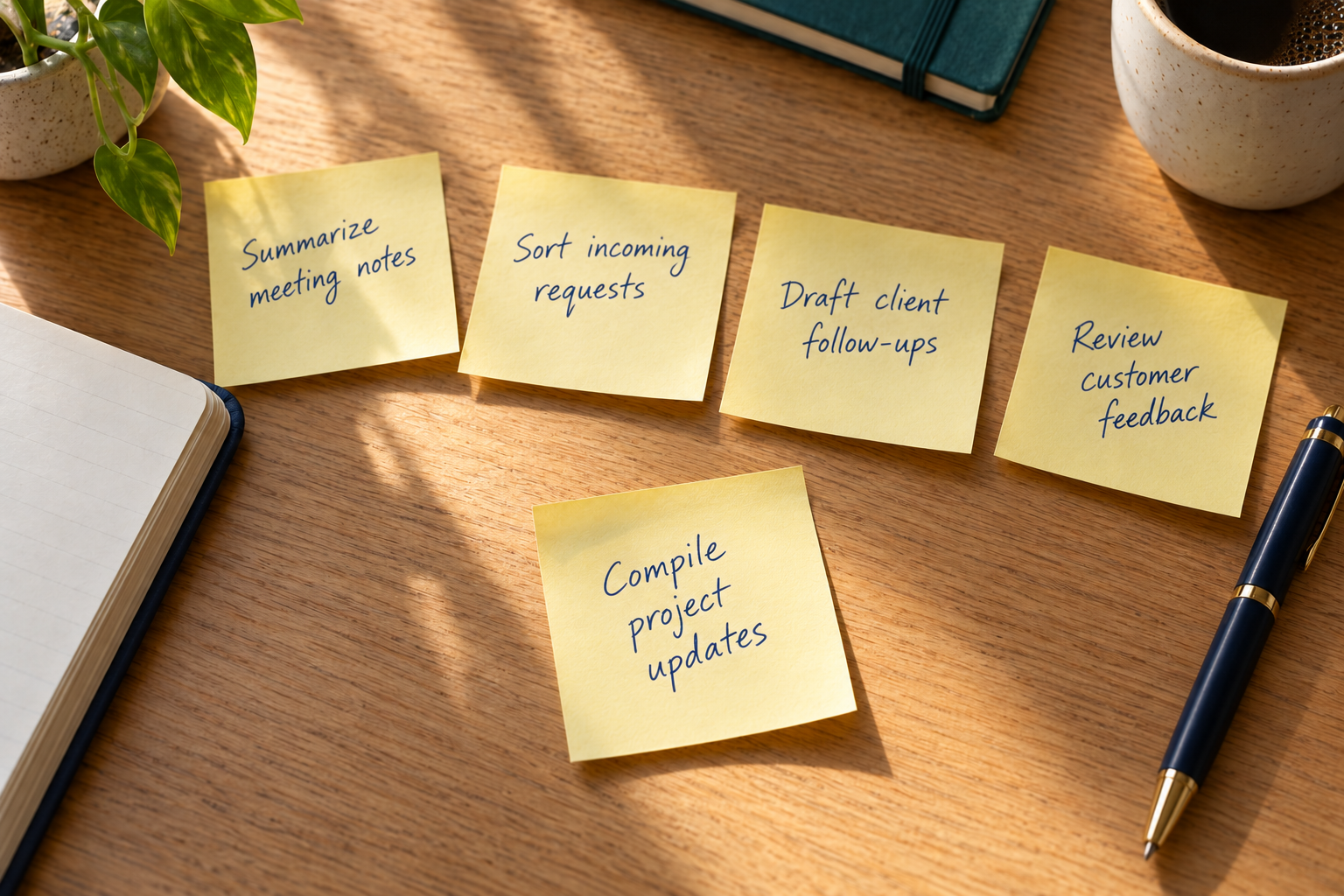
Your next AI opportunity may already be on your to-do list.
Let a small test answer a meaningful question
Once you’ve identified a promising use case, test it within a manageable scope. One recurring report, one team, and a few reporting cycles can give you something concrete to evaluate.
Before you begin, agree on what would make the test worthwhile. Less time spent? Fewer missed details? A more consistent output? Establish how the work gets done today so you have a meaningful comparison.
Then measure the whole task, including preparation, review, and correction. An AI-generated draft that takes minutes to produce may still require substantial checking. What matters is the total effort needed to get a result the team can use.
Ask the people doing the work what changed. Has the task become easier? Are they spending less time assembling information and more time acting on it? Or has the effort simply moved from writing to fixing?
The test may show that you’re ready to expand. It may reveal that inconsistent source information needs attention first, or that a simpler solution would work better.
Each outcome helps you make a better decision before committing more time and resources.
Choose useful over impressive
There is room for ambitious AI initiatives. Starting with a bounded problem doesn’t put a ceiling on what your organization can achieve.
It gives you a place to learn how AI fits into real work, what people need to use it effectively, and how to judge the results.
Your first worthwhile opportunity might be a weekly summary, an intake process, or a document someone is tired of assembling by hand. The task may be ordinary. Its impact on the people doing it can still matter.
If you’re deciding where to begin, ask your team: “What do we spend time on every week that we wish worked better?”
Then look closely at the answer.
Advisicon helps organizations evaluate where AI can improve work, clarify the processes around it, and put practical solutions into use. If you’re weighing potential AI use cases, we can help you identify a starting point and define what success should look like.