You’re at the end of a strategic planning meeting. You’ve agreed on what needs to change.
The reporting overhaul is overdue. Operations has an intake process everyone knows needs fixing. An AI pilot has a clear use case, and people want to try it.
You have capable teams, leadership buy-in, and a good reason to do all three.
Everyone’s ready to head back to their departments and build a roadmap. This is a good time to ask them to stay in the room a little longer.
The leadership team has agreed on what the business should do. Before departments start making commitments, that same group needs to agree on when the business can realistically absorb each change and what it’s willing to give up to meet an urgent deadline.

Look at the plan from the receiving end
Imagine you manage the operations team. In the same month, Finance needs your supervisors to validate the numbers for a new board report. The AI pilot needs two of your most experienced employees to test a workflow and document where it breaks down. You’re also supposed to train staff on the redesigned intake process.
Meanwhile, requests are still coming in at the usual pace.
Every initiative has an owner. Every owner can make a reasonable case for their timeline. And every timeline assumes Operations has room.
A department roadmap might show two weeks of testing. The people doing that testing can tell you it falls during their busiest week and that the only person who can cover their usual work is already helping with the reporting overhaul.
Bring those people into the conversation early enough for what they tell you to change the plan.
Work through the overlap together
Put the proposed initiatives on one timeline. For each one, mark when people will need to make decisions, validate data, test a workflow, learn a new process, or help others adopt it.
Then read across the timeline by affected team. What does a given week look like for Operations? What about Finance, IT, or the managers expected to lead several changes at once?
💡Three questions can help leadership turn that picture into a decision.
- What will actually change for each team? A new intake process might change what frontline staff ask for, who approves exceptions, and how supervisors handle escalations. Allow time for people to practice the new process and get help when they encounter a case the training didn’t cover.
- What needs to happen first? If the AI pilot will automate part of intake, the redesigned process may need to be settled before testing starts. If the pilot can answer the investment question using another workflow, leadership has more room to sequence the work.
- What happens if the date moves? A board meeting can give reporting a firm deadline. An internal target might have some flexibility. Ask what the business gains by keeping each date and what it would give up by moving it.
Put the busiest month on paper
Pick a month when several initiatives are expected to reach the same team. Ask each initiative owner to describe what they’ll need from that team in plain terms. Then ask the manager and a few people who do the work to check those assumptions.
They can tell you how long it takes to validate the numbers, who can cover routine work while someone is testing, and which weeks are already spoken for.
Here’s how a leadership team might work through the Operations example. The board packet is due this month, and leadership plans to make an investment decision on the AI pilot the following month.
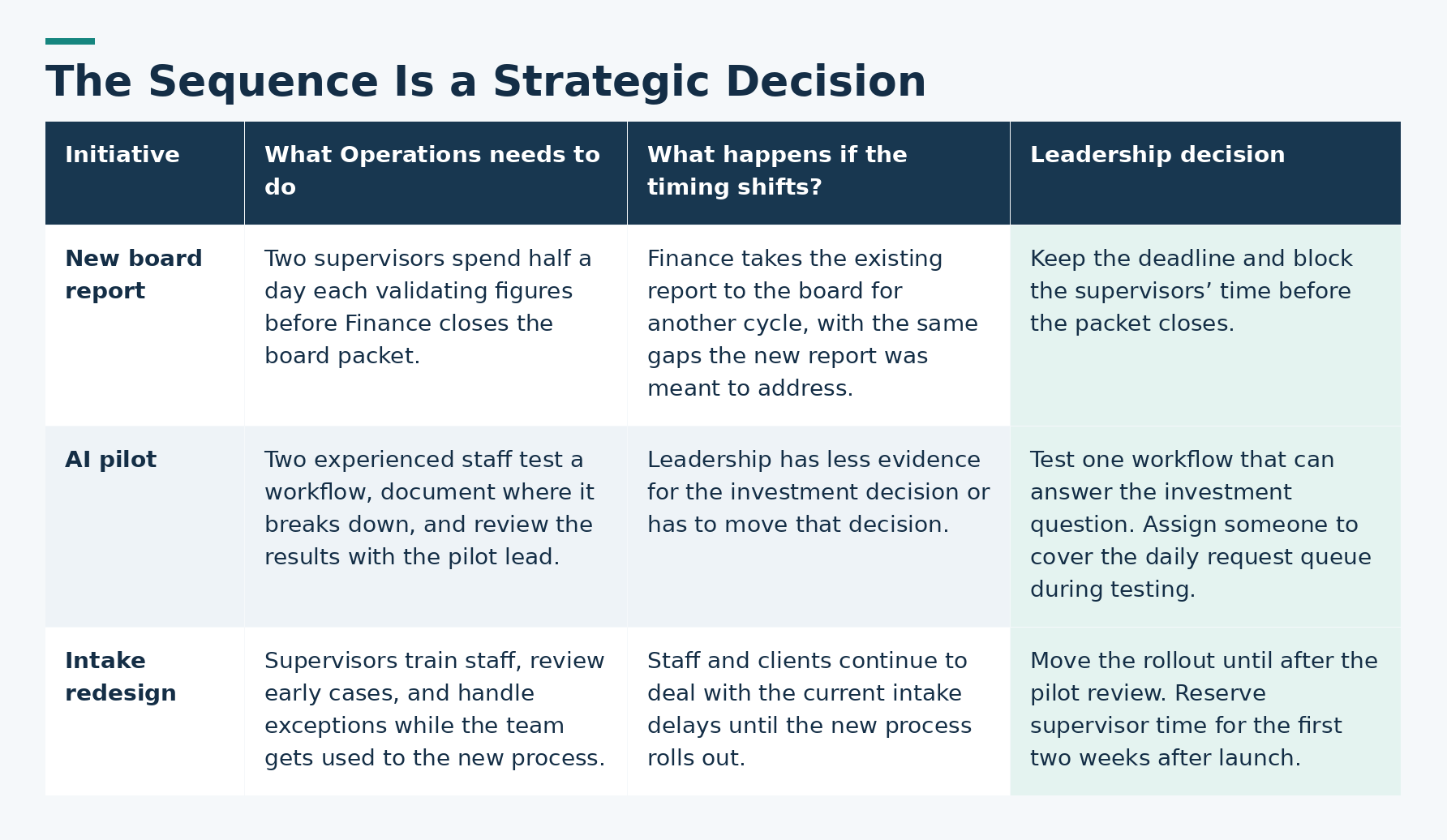
Pay particular attention to the last column. “Operations will make it work” leaves the decision with Operations.
“We’ll test one workflow, and the service desk will cover the daily request queue during testing” gives the manager something to schedule and explain to staff. The service desk lead still needs to confirm they have room. If nobody can cover the queue, the timing is still up for discussion.
Decide what would change your mind
In the worksheet, leadership has accepted a few more weeks of intake delays to protect the board reporting deadline and gather evidence for the AI investment decision.
That’s a trade-off the team can make deliberately. What would make it choose differently?
Say the intake delays are causing clients to miss service deadlines. Leadership might keep the board reporting date, move the pilot and its investment decision back a month, and use that time to roll out the redesigned intake process.
The supervisor time goes toward training and reviewing early cases. The business can address client impact sooner and delay the AI spending decision.
If all three dates really do have to hold, identify what other work will move or who can take it on.
For example, leadership could pause a planned internal review and free up the staff assigned to it. Check that those people have the skills and availability to cover the work Operations needs help with. A delay somewhere else only helps if it frees up the right people at the right time.
Give departments a plan they can explain
Before everyone leaves, ask each department lead to say what they’ll put in their roadmap.
The Operations lead should be able to tell staff what will change in their day-to-day work, when they’ll be asked to help, what will come off their plates, and who will support them after launch.
Give managers the reasoning, too. “We’re moving intake training so supervisors can be available to work through the first cases with you” is a decision people can plan around. It also gives the manager an answer when someone inevitably asks if training can move back up.
If Finance, IT, and Operations are still describing different versions of the plan, work through those differences while everyone is together.
Before your departments commit to their roadmaps, bring Advisicon into the planning conversation.
Our strategy and transformation consultants work with your leadership team to identify where initiatives compete for the same people, test proposed timelines with the teams doing the work, and help decide what to launch, narrow, or defer.
The result is a shared plan that spells out who needs to be involved, when their time is needed, and what leadership will take off their plates to make room. Talk with Advisicon about turning your strategic priorities into a plan your teams can deliver.